 User Interface: Viewing Master Datasheets
You can view master datasheets in Phrase & Data Library  > Master Datasheet.
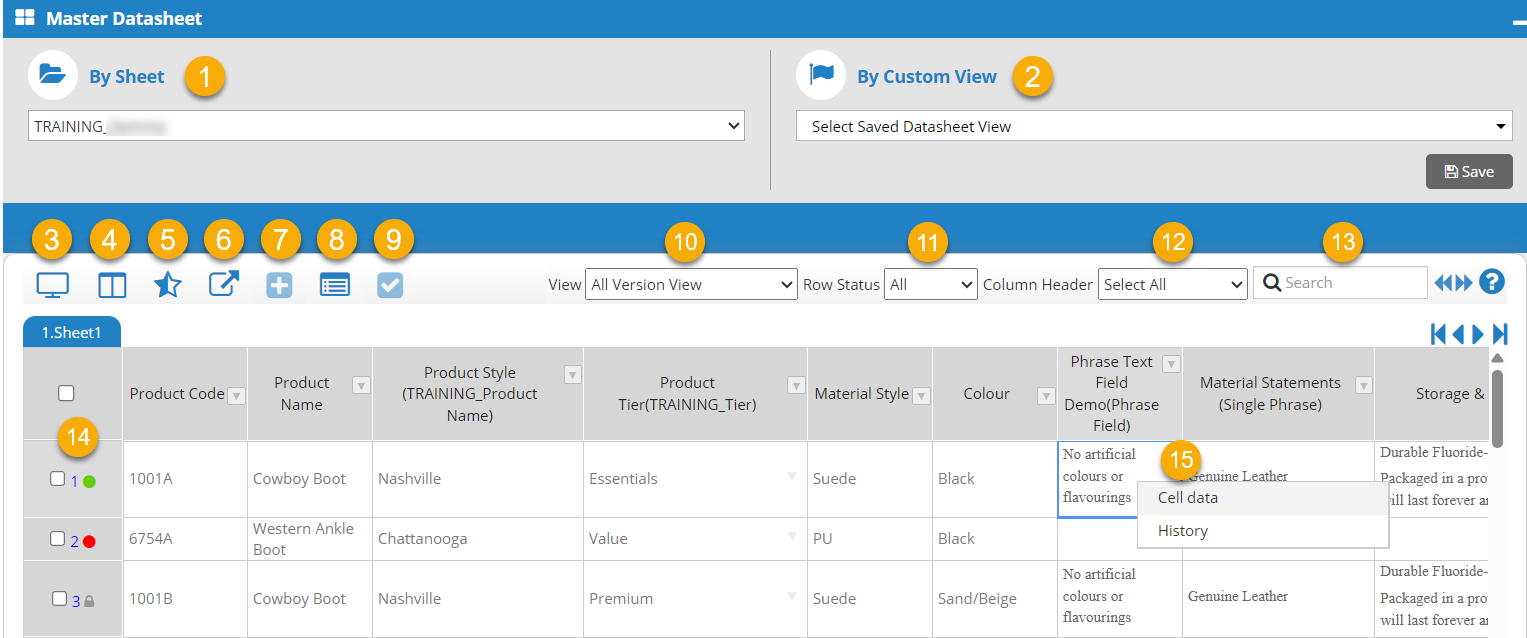
Master datasheets are an easy way to organize, store, find, and reuse content in packaging artwork projects. While project datasheets contain content tied to a specific project, master datasheets provide a central location to manage, edit, and organize content independent of projects. This allows you to reuse approved content in a master datasheet for multiple projects. You can also quickly create a project from a row or rows of data in a master datasheet.
|
|
Component |
Description |
|---|---|---|
| 1 |
By Sheet |
Select a master datasheet to display. |
| 2 |
By Custom View |
Select a previously saved filter to use. |
|
3 |
Full Screen |
Full screen view of the master datasheet. |
|
4 |
Row View |
Toggle or rotate the view so that the X and Y coordinates are reversed. The columns will display on the left and the rows will become columns. Comments can be viewed and added and in this display mode. |
| 5 |
Highlight Changes |
Highlight changes by date. |
| 6 |
Export |
Export the master datasheet contents and comments, if applicable, to an XLSX file. |
| 7 |
Add Project |
Create a new project from the selected row. |
| 8 |
Log View |
View logged activity of this datasheet. |
| 9 |
Show Selected |
Filter to display only the selected rows. |
| 10 | View |
Approved Version View: Filter the table to display only major approved versions. All Version View: Display all major and minor versions in the table. |
| 11 | Row Status | Filter to display rows based on row status. |
| 12 | Column Header | Filter to display columns based on column header property (set when the column was created). All columns reappear when you switch to edit mode. |
|
13 |
Search | Search the master datasheet contents. Supports OR search (enter multiple words to return results matching any of the terms) and phrase search (use quotes to return results matching the exact phrase). |
| 14 |
Row number |
Click to display the row number (ID), version, and status. |
|
15 |
Cell data |
Right-click a cell and then click Cell data or History to open the Edit Cell window with the corresponding tab displayed.
|
 more
more